
Emergency lighting plays a vital role in helping people leave a building safely if the normal lighting supply fails. But providing the correct equipment is only part of the responsibility. Emergency lighting also needs to be tested, monitored and maintained so that it is ready to operate when required.
For building managers, facilities teams and maintenance providers, keeping track of emergency lighting across a large or multi-site estate can be a time-consuming task. Automated emergency lighting testing offers another way to manage this responsibility, using connected luminaires to carry out scheduled tests and record the results digitally.
Why is emergency lighting testing important?
Emergency lighting must be kept in good working order, and routine testing helps identify faults before the system is needed in an emergency.
Traditional arrangements often rely on manual testing, recording results and following up on any issues identified. Across a building with many fittings, or an estate with multiple locations, this can create a considerable amount of work.
It can also be difficult to maintain a clear overview of system performance when records are spread across paper logbooks, spreadsheets or separate maintenance reports.
A more connected approach can help make the process easier to manage, while providing better visibility of the condition of the system.
What is automated emergency lighting testing?
An automated system uses connected emergency luminaires to carry out scheduled functional and duration tests. Rather than relying solely on someone to test each fitting manually, the system performs tests according to a configured schedule and records the results digitally.
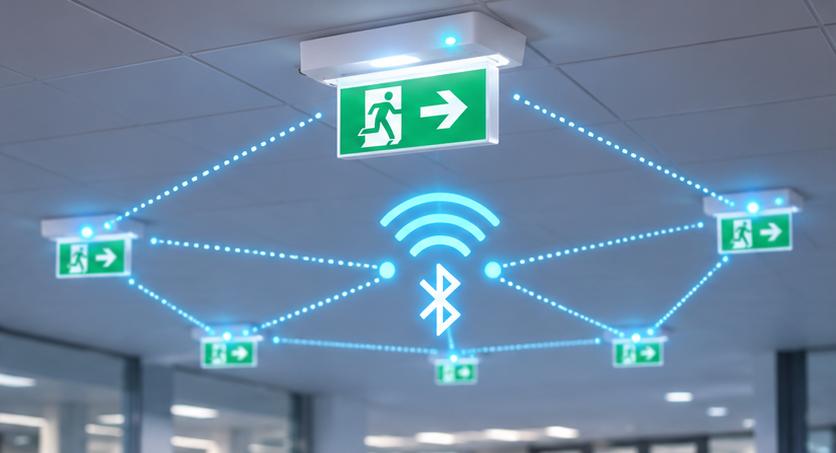
BLE’s DALI Mesh system uses Bluetooth® Networked Lighting Control (NLC) technology to create a decentralised wireless mesh network. Each compatible emergency luminaire acts as both a light fitting and a communication node, allowing information to pass between devices across the network.
The system can be configured through a commissioning app or web tool, where installers can identify fittings, organise them into groups or zones, and set appropriate test schedules.
From testing to reporting
One of the key benefits of automation is the way test information is recorded and made available.
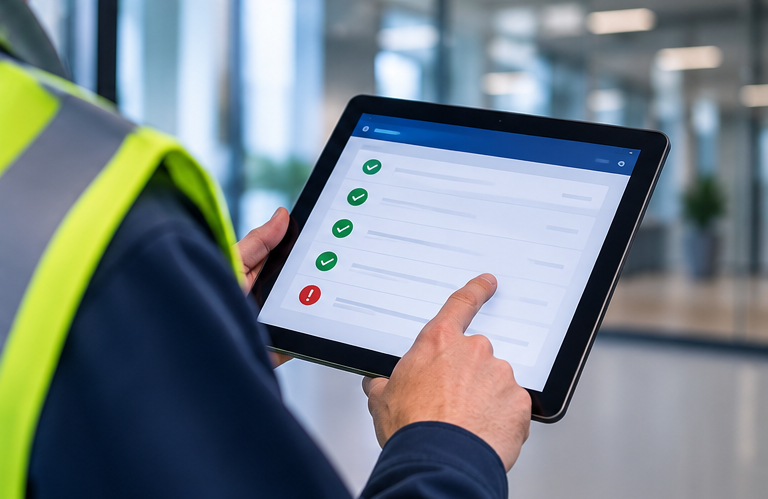
With BLE DALI Mesh, scheduled test results are logged automatically. Authorised users can access system status and reports through the management portal, helping them see how the emergency lighting is performing without having to gather information from every fitting individually.
The portal can provide visibility of:
Automated functional and duration test results.
Battery health and communication status.
LED or driver faults.
Emergency test failures.
Notifications and alerts relating to faults.
Reports can be exported for record-keeping, audits and inspections, while fault notifications help maintenance teams identify where further investigation may be needed.
The result is a clearer digital record of system performance and a more straightforward way to identify issues that require attention.
Is wireless automated testing suitable for existing buildings?
Wireless mesh technology can be particularly useful where additional communication cabling would be difficult or disruptive to install.
BLE DALI Mesh is designed to be scalable for both new-build and suitable retrofit projects. Its decentralised network allows compatible luminaires to communicate wirelessly, without the need for additional communication cabling between the fittings.
This can provide flexibility when planning a new installation or considering how an existing building could benefit from automated monitoring.
The suitability of any system will depend on the building, the proposed layout, the equipment specified and the project requirements. Planning and commissioning remain important parts of a successful installation.
Does automation remove the need for maintenance?
No. Automated testing helps simplify routine testing and record-keeping, but it should be viewed as part of an overall emergency lighting maintenance strategy.
Faults still need to be investigated, defective components addressed and the installation maintained in accordance with the applicable requirements. Building managers and responsible parties should ensure that their testing, inspection and maintenance arrangements remain appropriate for the premises.
Automation can make information easier to access and issues easier to identify, helping teams make more informed maintenance decisions.
A more connected approach to emergency lighting
As buildings become more connected, digital monitoring can offer practical benefits for the people responsible for keeping them safe and operational.
Automated emergency lighting testing provides scheduled testing, digital records and improved visibility of system status in one connected approach. For larger buildings and multi-site estates, this can help reduce the administrative effort involved in monitoring emergency lighting and managing faults.
BLE DALI Mesh combines wireless mesh communication with automated testing, reporting and remote system visibility — helping make emergency lighting easier to monitor and manage.
Want to find out more about automated emergency lighting control?
Contact BLE Lighting & Power to discuss the DALI Mesh system and its suitability for your project.
BLE Lighting & Power Ltd
01246 432325
[email protected]